Economic Empowerment Program
98% of domestic violence survivors experience economic abuse
We provide economic abuse services and resources to support survivors in creating sustainable pathways to economic safety and freedom
What is economic abuse?
Common signs include:
- Withholding money or restricting assets
- Not allowing a partner to work or forcing a partner to work and taking their wages
- Withholding important identification documents
- Opening credit cards or financial accounts in a partner’s name without their knowledge and then neglecting to pay the bills
- Coercing a survivor to open financial accounts with the threat or perceived threat of endangerment to themselves, children, and/or pets
Economic Empowerment Program (EEP)
Economic abuse, domestic violence, and homelessness are deeply interconnected. Nearly all survivors of domestic violence experience some form of economic abuse—often the primary barrier to leaving an abusive relationship. Economic instability is also a leading driver of homelessness, particularly for women, children, and families.
Urban Resource Institute’s Economic Empowerment Program (EEP) exists to change that reality.
EEP helps survivors and families move from economic harm to economic freedom—supporting pathways to safety, stability, and long-term self-sufficiency. Through trauma-informed, survivor-centered services, EEP works to interrupt cycles of poverty and violence and support families as they rebuild their lives with dignity and choice.
EEP serves adults and youth living in URI shelters and programs through flexible, accessible, and future-focused economic empowerment services, both in person and virtually. Our approach centers survivor autonomy and prioritizes access to living-wage employment and sustainable career pathways.
How We Deliver Economic Empowerment
EEP operates through a low-barrier, open-access model designed to meet survivors where they are.
- Services are customizable and choice-driven, allowing participants to engage in ways that align with their goals, readiness, and lived experience
- Financial empowerment support includes assistance for survivors impacted by coerced debt, identity theft, and economic control
- All services are grounded in an anti-oppressive, trauma-informed framework, addressing systemic barriers that disproportionately impact communities of color and other marginalized groups
- In addition to direct services, EEP advocates for policy and systems change that advance economic justice and dismantle structures that perpetuate economic abuse
Our Services
Individualized Economic Support
Participants work one-on-one with EEP staff to co-create personalized plans focused on economic safety, stability, and long-term security—grounded in their financial history, current circumstances, skills, and aspirations.
Career Readiness Workshops
Workshops support participants at every stage of their employment journey, including:
- Résumé and cover letter development
- Interview preparation and professional communication
- Workplace boundaries, conflict resolution, and navigating triggers in professional environments
Internships & Externships
Paid and unpaid opportunities with partner organizations help participants gain hands-on experience, build confidence, and translate skills into real-world settings.
Specialized Training Programs
Targeted skill-building opportunities in fields such as administration, bookkeeping, and other in-demand roles.
Job Placement & Employer Connections
EEP supports participants in connecting directly with employers and securing living-wage employment aligned with their goals.
Partner With EEP
EEP partners with a diverse network of employers, training providers, nonprofits, and community organizations to expand access to opportunity and strengthen economic pathways for survivors and families.
To learn more or explore partnership opportunities, contact us at: InfoEEP@urinyc.org
Advancing Economic Justice: Ending Coerced Debt
For many survivors of domestic and gender-based violence, abuse continues long after they reach safety—often in the form of coerced debt, when an abusive partner forces or manipulates debt into their name. This hidden form of economic abuse can destroy credit, block access to housing, and undermine long-term stability.
Urban Resource Institute played a critical role in changing that reality.
Through the leadership of URI’s Economic Empowerment Program (EEP), in close partnership with our Government Affairs team and survivors who bravely shared their lived experiences, URI helped advance New York’s Coerced Debt Bill, which has now been signed into law. This landmark legislation allows survivors to challenge and eliminate debt incurred through abuse—recognizing coerced debt as what it is: a continuation of violence.
Leadership
The Economic Empowerment Program is led by Program Director Olga Laoiza, whose work centers economic justice, survivor empowerment, and systems-level change.
EEP staff work directly alongside participants to provide the tools, resources, and support needed to end cycles of violence and homelessness—and to build futures rooted in stability, opportunity, and hope.
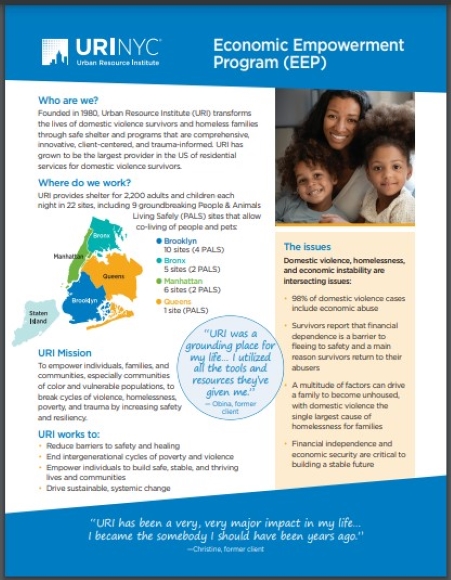
Click Here for Economic Empowerment Program Overview
Reinvesting in Economic Justice, Equity, and Solidarity for Survivors in New York City
In their journey from surviving to healing, URI clients receive the support—and build the confidence—needed to forge pathways to safe, stable, and hopeful futures. For many individuals and families, gaining financial freedom and self-sufficiency through URI is transformative, opening doors they once believed were out of reach.
Below, hear directly from three survivors and former URI clients as they share their powerful journeys—from economic harm to independence—and how the right support helped them move from trauma to triumph.